Hydrogel Bioprinting for Tissue Engineering

Tissue engineering aims to create biological substitutes that can restore or replace damaged tissues, offering new possibilities for regenerative medicine and transplantation. While conventional approaches have laid important groundwork, advances in bioprinting and hydrogel materials are reshaping the field by enabling greater precision and biological relevance in engineered tissues.

Bioprinting allows living cells and biomaterials to be deposited layer by layer according to digital designs, making it possible to reproduce the complex organization found in natural tissues. This level of control is essential, as tissue function depends not only on the types of cells present but also on their spatial arrangement and interactions. By guiding this process from the outset, bioprinting supports the formation of more functional and organized tissue structures.

Hydrogels provide an ideal environment for this approach. These water rich polymer networks closely mimic the body’s extracellular matrix, offering both mechanical support and a biologically favorable setting for cells. Within hydrogels, printed cells can attach, grow, migrate, and differentiate while receiving nutrients and oxygen through diffusion. The physical and chemical properties of hydrogels can also be tuned to suit different tissue types, enhancing their versatility.

Embedding cells within hydrogel scaffolds offers additional advantages, including the ability to incorporate growth factors and other bioactive molecules that influence cell behavior and tissue development. This combination enables the creation of complex constructs that more closely resemble native tissues. It has already been applied to engineering skin, cartilage, bone, vascular structures, and early stage models of organs such as the liver and heart, with promising implications for patient specific therapies.

Despite these advances, challenges such as achieving proper vascularization, optimizing bio inks, and addressing regulatory considerations remain. Even so, the integration of bioprinting and hydrogels represents a powerful step forward in tissue engineering. As research continues to refine these technologies, they hold strong potential to transform how functional tissues and organs are developed for clinical use.

Nano-Technology, a Beginner’s Guide

What is Nanotechnology?

Nanotechnology is the science of working with materials at an incredibly small scale. So small, in fact, that it deals with structures measured in nanometers. A nanometer is one billionth of a meter. To put that into perspective, a human hair is about eighty thousand nanometers wide. At this scale, materials can behave in surprising and useful ways.

At its core, nanotechnology is about understanding and controlling matter at the atomic and molecular level. When materials are reduced to this size, their physical, chemical, and optical properties can change. Scientists and engineers use these changes to design new tools, devices, and materials that perform better than their larger scale counterparts.

When something becomes extremely small, the rules it follows begin to shift. Gravity becomes less important, while quantum and surface effects become more dominant. This means a material might conduct electricity differently, react faster with other substances, or interact with light in a unique way. These effects are what make nanotechnology so powerful and versatile.

Gold is a good example. In everyday life, gold looks shiny and yellow. At the nanoscale, gold particles can appear red or purple and can be used to detect diseases or improve medical imaging. The material is the same, but its behavior changes because of its size.

Nanotechnology is already part of daily life, even if it is not always visible.

In medicine, it is used to improve diagnostics, drug delivery, and medical sensors. Nanoparticles can help doctors detect illnesses earlier or deliver treatments more precisely inside the body.

In electronics, nanotechnology enables smaller, faster, and more energy efficient devices. Modern smartphones, sensors, and computer components rely on nanoscale engineering to function the way they do today.

In agriculture and environmental monitoring, nanosensors can detect changes in soil quality, air pollution, or water safety in real time. This helps support sustainability and better resource management.

In materials science, nanotechnology leads to stronger coatings, lighter materials, and surfaces that resist heat, wear, or contamination.

Nanotechnology brings together many fields. Physics, chemistry, biology, and engineering all play a role. Researchers use advanced tools like electron microscopes, cleanroom fabrication systems, and optical measurement techniques to design and study materials at this scale.

Some nanomaterials are built atom by atom, while others are created by refining larger materials until they reach the desired size. Both approaches require precision, creativity, and a deep understanding of how matter behaves.

Like any advanced technology, nanotechnology requires responsible development. Researchers carefully study how nanomaterials interact with people and the environment. Safety testing, regulation, and ethical research practices are an important part of the field. When developed thoughtfully, nanotechnology offers meaningful benefits while minimizing risk.

Nanotechnology helps solve real world problems. It supports better healthcare, smarter technology, cleaner environments, and more efficient systems. Many of today’s innovations, from advanced sensors to sustainable materials, are possible because scientists learned how to work at the nanoscale.

As research continues, nanotechnology will play an even greater role in shaping the future. Understanding the basics is the first step toward appreciating how something so small can have such a big impact.

Driving Biomedical Discovery with Nanosensors

Advancing Biomedical Research with Nanosensors and Seed NanoTech Innovation

Biomedical research relies on tools that measure the smallest biological signals with high precision. Understanding biomolecular changes, tracking disease markers, and monitoring physiological processes have all improved dramatically through advances in sensor technology. Nanoscale sensors bring sensitivity, speed, and specificity that traditional tools cannot match, opening new pathways in diagnosis, monitoring, and fundamental discovery. These tiny devices operate at the scale of biological molecules, enabling detection of proteins, nucleic acids, and cellular activity at ultra-low concentrations. Researchers value nanosensors for their ability to provide detailed insights into biological systems, streamline experimental workflows, and support point-of-care applications that could transform patient outcomes.

Nanosensors are finding roles throughout biomedical research. They can detect disease-related biomarkers earlier and at lower levels than many conventional methods, supporting faster and more accurate studies of disease progression. These sensors also contribute to monitoring therapeutic responses, offering real-time feedback that can improve experimental design and clinical strategies. High sensitivity and selective performance are critical for research focused on complex biological environments, where subtle changes in molecular signals carry significant meaning.

Seed NanoTech is responding to this need with a portfolio of nanosensor products built on advanced optics, plasmonics, and magnetic principles. The company’s sensors leverage combined physical effects to deliver highly sensitive, label-free detection that works across a variety of research contexts. These sensors are designed to support accurate measurement while remaining affordable and versatile for labs and research teams.

Seed NanoTech’s platform includes magneto-plasmonic sensors that improve sensitivity and detection capabilities compared to many existing alternatives. Their approach integrates these principles into compact, adaptable designs that researchers can apply to biomedical diagnostics, fundamental studies of biological processes, and early detection of molecular signatures associated with disease. By focusing on enhanced performance and practical usability, Seed NanoTech’s innovations help empower scientists to explore biological questions with greater clarity and confidence.

The expanding role of nanosensors in biomedical research reflects a broader shift toward technologies that capture biological complexity at the smallest scales. As research demands continue to grow, tools that offer precise, rapid, and reliable measurement will be essential. Seed NanoTech is contributing to this evolution with sensor technologies that align with the needs of modern research, supporting discoveries that may lead to better understanding of disease and improved health outcomes.

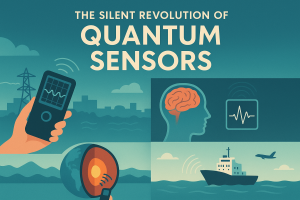
The Silent Revolution of Quantum Sensors

The Silent Revolution of Quantum Sensors

The world is entering a new age of measurement where some of the smallest particles in existence are becoming our most powerful tools. Quantum sensors are moving from research labs into real world industries and the shift promises to reshape the way society monitors the environment, manages resources, and discovers new scientific insights.

Quantum sensors use the strange behavior of atoms and electrons to detect tiny changes in gravity, magnetic fields, and time. These changes were once far too subtle for traditional instruments to register. Now they can be captured with remarkable precision. This opens the door to breakthroughs that can influence fields from medical imaging to geological exploration.

Imagine a handheld device that can map underground structures without drilling a single hole. Quantum gravity sensors are beginning to make this possible by detecting minute differences in the pull of Earths mass below the surface. Companies in construction, mining, and energy exploration are already testing early models because the potential savings and safety improvements are enormous.

Medical research is also paying close attention. Quantum sensors that respond to extremely small magnetic fields may lead to a new generation of heart and brain imaging. These devices could capture electrical activity inside the body with clarity far beyond what current machines can achieve. Early detection of neurological disorders could become far more accurate which is a goal shared by doctors around the world.

Even navigation could be transformed. Ships and aircraft traditionally rely on satellite systems that can be disrupted by storms or interference. Quantum sensors can track movement through measurements of time and motion alone which creates a path toward navigation systems that do not depend on external signals.

The progress is rapid but challenges remain. Many systems still require cold temperatures or delicate equipment. Engineers and physicists continue to work on versions that can operate in harsh environments or fit into compact casings suitable for field use. As these hurdles fall the impact will grow.

Quantum sensing represents a quiet revolution. It advances through precision rather than power and through deeper observation rather than bigger machines. As these instruments spread into industry and research they will reveal details about our world that we were never able to measure before.

The next decade may be one of discovery built not on guesswork but on extraordinary clarity. In science and business the ability to observe more clearly is often the key to progress and quantum sensors are poised to provide that clarity in remarkable ways.

Why Science Cannot Truly Progress If It Only Serves Material Ends

Why Science Cannot Truly Progress If It Only Serves Material Ends

Science has given humanity extraordinary tools: vaccines, electricity, microchips, satellites, and entire digital worlds woven from code. It has extended our lives, shrunk distances, and reshaped our economies. Yet beneath these astonishing achievements lies a subtle danger, one that becomes clearer the faster technology accelerates. Science that orients itself solely toward material outcomes eventually undermines the very progress it aims to create.

The Paradox of Material Only Progress

When scientific endeavor becomes tightly coupled with material gain such as more profit, more speed, more efficiency, and more consumption, it risks shrinking its own purpose. Science was never meant to be only a mechanism for producing things. It was born from wonder, curiosity, and the desire to understand our place in the universe.

But when material outcomes become the benchmark for usefulness, entire realms of scientific inquiry are devalued. Fundamental research without immediate profit comes to be seen as impractical. Ethical questions are treated as barriers. Environmental limits are dismissed as externalities. In this paradigm, progress is measured by production and power rather than meaning, sustainability, or human well being.

Material Driven Science Creates Blind Spots

Science focused only on material ends tends to ignore questions that do not yield quick payoff. This creates three major blind spots.

1. The Human Blind Spot

Science becomes detached from the humanities, including ethics, philosophy, psychology, and spirituality. These disciplines ask why rather than how, and without them science loses its compass. A society may construct increasingly powerful tools yet lack equally strong guidance for how to use them wisely.

2. The Ecological Blind Spot

When science serves only material expansion, natural systems are reduced to resources rather than understood as relationships. This mindset has contributed to climate disruption, biodiversity collapse, soil exhaustion, and a dangerous imbalance between human technology and planetary limits.

3. The Meaning Blind Spot

Human beings desire more than long lives. We also seek deeper and richer experiences that give those lives significance. If scientific advancement fails to support the cultivation of meaning, wisdom, and human flourishing, then its achievements begin to feel hollow. In a purely material logic, loneliness, nihilism, and disconnection fall outside the boundaries of what science is expected to address.

The Cost of Ignoring the Non Material

The consequences of material focused scientific thinking are already visible. Technologies that were created to connect us often heighten isolation. Medical systems that can treat disease may still neglect the need for community or mental health. Economies built around growth metrics frequently overlook inequality and human well being. Scientific innovation sometimes generates new crises as quickly as it resolves old ones. Material progress without moral, ecological, and existential grounding becomes a treadmill that moves faster and faster without clear direction.

Science Needs a Larger Vision

To continue advancing in any meaningful way, science must reclaim a broader purpose, one centered on the pursuit of truth and human flourishing rather than mere utility.

This shift does not require abandoning technology, profit, or engineering. Instead, it calls for complementing those pursuits with deeper questions. We must ask how our discoveries can enhance life for all rather than a select few. We must consider what forms of innovation can honestly be described as responsible. We must explore how scientific progress can remain aligned with ecological balance. We must reflect on what human beings truly require to thrive rather than simply endure.

When research is guided by questions like these, science becomes more humane and more resilient. Fields such as systems biology, environmental science, mental health research, artificial intelligence ethics, and public interest technology reveal the strength of an approach that blends material and non material values.

Toward a Science of Wholeness

The future of science will be shaped less by the speed of its discoveries and more by the wisdom with which those discoveries are applied.

Ethics gives science a path toward justice. Ecology provides a foundation for sustainability. Philosophy opens the door to meaning. Compassion leads to human flourishing.

For science to advance in both power and purpose, it must reconnect with the full spectrum of human inquiry. It must return to questions such as What can we do and What should we do.

Only through this broader vision can science help create a future that is not simply more advanced but more fully alive.