
Where inventions reach limitations
Dr. Rizal is a guest editor of Special Issue of Magnetoplasmonics:

https://www.mdpi.com/journal/condensedmatter/special_issues/Magnet_plas

Dr. Rizal is a guest editor of Special Issue of Magnetoplasmonics:
https://www.mdpi.com/journal/condensedmatter/special_issues/Magnet_plas

Magneto-optic-plasmonics (MOP) is a relatively new class that merges the three sub-fields: optics, magnetics, and plasmonics of science. The main ingredients of MOP material are ferromagnetic and ferromagnetic oxide materials like Fe, Co, Ni, magnetite, etc. where any change in permittivity tensor is conveyed by the presence of an applied external force or a magnetic field. The permittivity tensor is also dependent on the frequency of the incident optical radiation.
Magneto-optic materials can be used in various areas. These include determination of dynamic studies of film growth, detection of magnetic impurities, average free carrier effective mass, MO filters, atomic line filters, field sensors, memories, modulators and integrated optoelectronic devices like optical circulators, switches and isolators. The drives using thermomagnetic recording and magnetic recording also use MO materials. Some other fields where MO materials are used include spintronics and MO microscopy. The most recent application is the biomedical field where efforts are in process to develop a biosensor that is the most sensitive to date.
The discovery of magneto-optic effects in metals and dielectric is not new (it was very first discovered and demonstrated by Michael Faraday in 1845). However, the application of MO in spintronics and recording have been found only in the 1990s. The importance of magneto-optic in sensing and imaging has emerged only in the last decade.
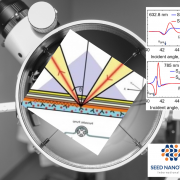
The recent application of magnetic-field on bio-sensing is shown in the picture below. The picture demonstrates a right-angled isosceles prism, indexed matching liquid, lenses, buffer layer, optical laser source, a substrate with transducer/sample and a photodetection (PD) system.
The future of magneto-plasmonic based nanostructures is extremely bright. These nanostructures display exceptional properties like high sensitivity, strong enhancement of electromagnetic fields, the possibility of obtaining high photothermal conversion efficiencies, large signal to noise ratio and rich spectral responses at applied magnetic fields, makes them outstanding, unique and sought for material for various applications.
The application of magnetoplasmonics has a vast range of possibilities in a number of fields including clinical therapy, biophysics, diagnostics, bio-imaging, environmental monitoring, biophysics, chemical and biological sensing, ultra-fast molecular sensing for early disease detection, magneto-plasmon-enabled photo-thermal therapy, magneto-plasmon-assisted laser welding, plasmon-assisted photo-acoustic imaging and magneto-plasmon-enhanced spectroscopies, like SERS for magneto-plasmonic structures and fields are expected to extend the production of energy and in the exploration of space as well.
Some other additional areas where magnetoplasmonic-based devices and structures can be used are magneto-plasmon based isolators, photo-detectors, harvesting and conversion of solar energy along with the coupling of magneto-plasmons to chemical reactions in order to achieve high selectivity and activity for energy saving, switching and sensing and tuning of magneto-optical properties at the femtosecond speed.
Some other highly promising areas where the potential of this technology can be fully utilized include the development of bio-nanomagnetic and magetoplasmonic bioengineering, high-performance magnetronic devices and green energy, biomedicine and biology to mention a few.
Dr. Rizal has done extensive research on Magneto-optic-plasmonics and his paper can be accessed Here
[wpforms id=”15215″]
Surface Plasmon Resonance (SPR) is the reminiscent oscillation of electrons conductions stimulated by incident light at the interface between negative and positive material. Through SPR the binding of the molecules can be measured in real-time without the use of any labels.
Surface Plasmon Resonance is used to observe the change in refractive index at any surface. SPR occurs when the total internal reflection of polarized light takes place at a metal film. SPR instruments are generally used to measure affinity and the binding kinetics of the molecular interactions. SPR can be used to measure the binding between a protein and an antibody or in between two proteins or in between DNA and a protein and many more.
The technique of SPR is unique because it is among one of the few techniques which allow the determination of binding kinetics, not just binding affinity which is commonly observed in traditional techniques like ELISA. The determination of binding kinetics is only through a biosensing technique that provides the real-time data of both the association and dissociation phases of the interaction. This data provides insights of both the binding stability and stability of the interaction in detail. Such insights are very critical for many industries and research areas as they help researchers to determine the molecules which are interacting also why are they interacting and how strongly do they interact.
There are several advantages to SPR. Some of them include:
The SPR data is critical in many industries and has been in use for over 25 years by companies like GSK, Roche and Pfizer and by many universities throughout the world. Some examples of applications include:
To know more about it, Click Here.
[wpforms id=”15215″]

A biosensor is a diagnostic device used for the detection of a physical or chemical substance that combines a biological component with a physio-chemical detector. The reader of the biosensor device connects with the signal processors or associated electronics, which are primarily responsible for the display of results in a user-friendly manner. Now it is possible to generate a user-friendly display that includes a transducer and sensitive elements.
There are primarily two types of biosensors, some are portable and others are either the fixed type or bench-type. Some examples are electrochemical, catalytic Bead, photoionization, infrared, infrared Image, ultrasonic, holographic detectors/sensors and more recently surface plasmon resonance (SPR) and magneto-optic (MO) surface plasmon resonance (MOSPR)-based sensors.
The major requirement of any biosensors depends on the approach in terms of commercial applications and research in the identification of the target molecule, as well as the availability of an appropriate biological recognition element.
The most common and best example of a commercial biosensor is the blood glucose biosensor. This sensor utilizes the glucose-oxidase enzyme that breaks down the glucose. In this process of breakdown, it first oxidizes glucose and uses two electrons to reduce the flavin adenine dinucleotide (FAD) — an enzyme component to FADH2 which is then oxidized by the electrode in several steps. The resulting current is a measure of the concentration of glucose. In this scenario, the electrode is the transducer, and the enzymes are the biologically active components.
Most optical biosensors are based on the principle of surface plasmon resonance (SPR). The SPR occurs when a thin layer of gold on a high refractive index glass surface absorbs the laser light and produces electron waves (known as surface plasmons) on the gold surface. This condition arises at a specific angle and wavelength of the incident light. The phenomena depend on the binding of a target analyte to a receptor that produces a measurable signal.
One way the SPR sensors operate is by using a sensor chip. The chip consists of a plastic cassette supporting a glass plate, coated with a microscopic layer of gold on one of the sides. where the optical detection apparatus of the instrument lies. The opposite side of the plate is then attached to the microfluid flow system that allows the passage of reagents in the solution.
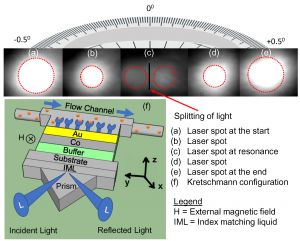
The glass sensor chip of this side can be modified in a number of ways, which allows easy attachment of molecules of interest. Hence, the refractive index at the flow side of the chip surface has a direct influence on the behaviour of the light reflected off the sensor side. The flow side of the chip has an effect bonded on the refractive index of the material of interest and in this way, biological interactions are measured to a high degree of sensitivity. As a result, the refractive index of the medium changes near the surface when the biomolecules are attached to the surface and the angle of SPR varies as the function of this change.
Biological biosensors are designed from a genetically modified form of a native protein or enzyme. The protein is configured for the detection of a specific analyte and the ensuing signal is read with the help of detection instruments such as fluorometers or luminometers, to name a few. To read more about “Biosensors” Click Here.